
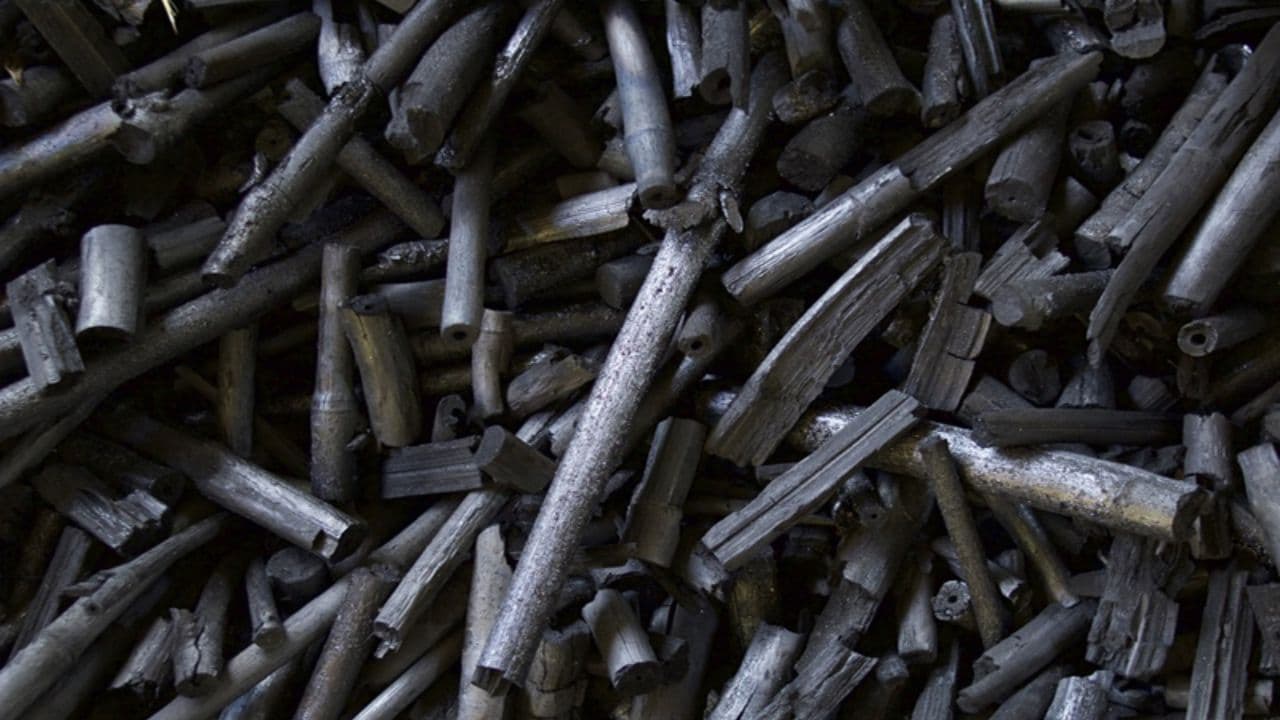
Someone rang us last week. He has 200 tonnes of bamboo. He wants to make biochar out of it. He is not an engineer, and he should not have to be one to get an answer.
So this guide is for him, and for anyone else sitting on a pile of bamboo. Plain words, real numbers, and an honest answer about the money at the end.
What biochar is, in one line
Biochar is charcoal made on purpose, to go into soil instead of into a stove.
That is really it. Same black material. Different reason for making it. Ordinary charcoal is made to be burned later. Biochar is made to be buried, where the carbon stays locked away for hundreds of years and the soil around it holds more water and more nutrients.
The proper word for the process is pyrolysis. It just means heating wood with very little air. Give wood plenty of air and it burns away to grey ash. Give it very little, and it stops halfway and leaves you with black carbon. Ash is worth nothing. Black carbon is your product. (For the fuller picture — uses, benefits, prices — see what biochar is.)
How much biochar will 200 tonnes of bamboo give you?
Less than most people expect. Here is why.
Freshly cut bamboo is full of water — roughly 40 to 55% of its weight. So 200 tonnes off the field is really about 100 tonnes of bamboo and 100 tonnes of water. After a couple of months drying in the open, you are left with something like 100 to 120 tonnes.
Then the fire takes its share. A well-run kiln turns 20 to 30% of that dry weight into biochar. An old-style earth pit gives you only 10 to 15%, and poor quality at that.
Weigh a sample before you plan anything around these numbers. If your bamboo has already been lying in a yard for a year, it is far drier already, and your yield will be better.
Step 1 — Dry it. This decides everything.
Wet bamboo will not make good biochar. The fire spends all its energy boiling water off, the temperature never climbs high enough, and you end up with smoke, tar and a soft brown char that nobody wants to buy.
- Cut and stack it two to three months before you plan to burn.
- Stack it off the ground — on stones, poles, anything. Ground moisture creeps back up into it.
- Split the culms. A whole pole dries from the outside only; the inside stays wet for months.
- Leave gaps so air moves through the stack. Cover the top against rain, but leave the sides open.
If you do only one thing properly, make it this one.
Step 2 — Cut it small
Bamboo is hollow. A kiln loaded with whole poles is mostly full of air, and you will burn a lot of fuel to make very little char.
Split the culms lengthways and cut them into pieces roughly 30 to 60 cm long, or chip them if you have a machine. Pieces of a similar size burn evenly, and even burning is what gives you char of consistent quality.
Step 3 — Choose how you will burn it
Five common options. Be honest with yourself about your budget and your volume.
| Method | Rough cost | What you get | Good for |
|---|---|---|---|
| Earth pit or mound | Almost free | Poor char, heavy smoke, 10–15% yield | Nothing, honestly — avoid it |
| Flame-curtain kiln (Kon-Tiki) | ₹15,000–1 lakh | Good char, little smoke if run right | Farms, first-timers, a 200 t job |
| Oil-drum TLUD | ₹2,000–10,000 | Good char, tiny batches of 20–50 kg | Trying it out, kitchen gardens |
| Batch retort | ₹5–30 lakh | Very good, consistent char | A small business with steady supply |
| Continuous reactor | ₹1 crore and up | Excellent char, runs all day | Full carbon projects |
For 200 tonnes, the flame-curtain kiln is the sensible answer. It is a wide metal cone, or a sloped pit dug in the ground. One or two of them, run over a season, will get through your pile. Treat the costs as indicative and get local quotes. If you are weighing bigger equipment, our guide to choosing pyrolysis technology goes deeper.
Step 4 — Burn it right
The flame-curtain method sounds odd the first time you hear it: you keep a sheet of flame burning on top, and that flame acts as the lid. It burns the smoke, and it stops air reaching the char underneath. That is the whole trick.
- Light a small fire at the bottom of the cone. Not the top.
- Once it is burning well, add a thin layer of bamboo right across the surface.
- Wait until that layer is covered in flame and the white smoke has gone.
- Add the next thin layer. Never dump in a big load — it smothers the fire and makes smoke.
- Repeat. Layer, wait, layer. The char builds up underneath, protected by the flame above.
- Keep going until the cone is full and glowing black-red all the way through.
Watch the smoke, not the clock. Thick white smoke means you added too much, too fast. A clear shimmer of heat with flame sitting on top means you are doing it right.
Step 5 — Put it out before it turns to ash
This is where people lose half a day's work.
The moment the last layer has stopped smoking and the whole bed is glowing, stop and quench it. Flood it with water, or cap it completely with soil or a steel lid to cut off all the air. Leave it alone and it will quietly keep burning down to grey ash overnight.
Step 6 — Charge it before it touches your soil
Fresh biochar straight out of the kiln is hungry. It is full of empty pores, and the first thing it does in soil is soak up nitrogen — the same nitrogen your crop was waiting for. Farmers who skip this step often get a worse first season and decide biochar does not work.
Fill those pores before you plant. Any of these will do it:
- Mix it into your compost heap and leave it a few weeks.
- Soak it in cow-dung slurry, urine or diluted manure for a week.
- Use it as animal bedding, or as a small feed supplement, and let the animals charge it for you.
Crush it down to about the size of coarse sand first. Then mix it into the top soil rather than leaving it lying on the surface, where the wind will simply take it away. There is more on this in our guide to how biochar builds soil carbon.
What is it actually worth?
Here is the honest part, and it is the part most people get wrong.
Selling the char itself
This is money you can earn this year. Biochar and bamboo charcoal both have real buyers in India — nurseries, horticulture, soil-mix makers, and the existing charcoal trade. Bulk prices vary a lot by region and quality, but somewhere around ₹10 to ₹30 per kg is a common starting point. On 25 tonnes that is roughly ₹2.5 to ₹7.5 lakh. No audits, no paperwork, no waiting.
Selling carbon credits
Every tonne of good biochar locks away roughly 2 to 2.8 tonnes of CO2. So 25 tonnes of char is around 50 to 80 tonnes of CO2 removed. At current durable-removal prices of roughly US$80 to $150 per tonne, that looks like ₹3.5 to ₹10 lakh.
It looks good. Now read the next paragraph.
So what does work? Two things.
Volume that repeats. Carbon projects are built on supply that arrives every year, not once. This is where bamboo is genuinely good news: it is a grass, not a tree, and a managed clump can be cut again and again. A standing bamboo plantation with an annual harvest can become a real project. One truckload cannot.
Joining a group. Small producers can supply into an aggregated project — an FPO, a cooperative, or a developer who pools char from many suppliers and spreads the audit cost across all of it. You sell char; they carry the registry work. Read how FPOs and aggregators can co-own a project before you sign anything, and make sure your share of the carbon revenue is written down. We also work directly with FPOs and cooperatives on exactly this.
One more thing worth saying plainly. If you cut down healthy bamboo only to make biochar, that is not carbon removal — you have simply moved carbon out of a living plant and into a bag. Credits hold up when the material is genuinely surplus: thinnings from a crowded clump, over-mature culms past their useful life, offcuts from a bamboo workshop, storm-damaged material. Auditors check this, and buyers ask.
A few things specific to bamboo
It grows back, fast. Unlike a tree, a harvested bamboo clump sends up new culms the next season. Cut selectively — take the older culms, leave the young ones — and you have a supply that lasts.
You usually do not need a permit. Since the Indian Forest (Amendment) Act, 2017, bamboo grown on non-forest land is no longer treated as a "tree", so felling and transit permits are generally not required. State transit rules still differ, so ask your local forest office before you move a truckload.
Some species carry a lot of silica. That leaves more ash in the char and slightly less carbon. It does not stop you making biochar — it just means your lab numbers may look different from a wood-based char. Worth knowing before you promise anyone a specification.
Five mistakes that ruin a batch
- Burning wet bamboo. Smoke, tar, soft char. Wait the two months.
- Loading whole poles. Mostly air. Split them.
- Adding too much at once. It smothers the flame and makes exactly the smoke you were trying to avoid.
- Letting it burn down to ash. Grey means you waited too long. Quench while it is black.
- Putting raw char straight into soil. Charge it first, or your first crop pays for it.
Where to start
If you have bamboo and want to test the idea, start small. Build or borrow one flame-curtain kiln. Dry a few tonnes properly. Run three or four burns. Weigh what you get, and try selling a sample locally. You will learn more from that than from any spreadsheet, and you will have risked very little.
If the numbers look promising and you are thinking about scale — or you have a standing bamboo plantation and want to know whether a proper carbon project is realistic — that is a question worth answering with real figures before you spend money. Read more about choosing pyrolysis equipment, see how we assess feedstock and feasibility, or request a biochar project feasibility assessment and we will work through your own numbers with you.
Figures in this article are estimates as of August 2026 and will vary with your bamboo species, moisture, equipment and location. Prices in both carbon and charcoal markets move. Carbon credit revenue is never guaranteed, feedstock must be genuinely sustainable, and permit rules differ by state — verify locally before you commit money.